She clicked the link and a new page appeared on-screen. How strange that this simple act would change her life forever.
It was the warning that captured her. Allegedly, the story of Lyemouth was a true one, and not only that – it was yet to occur. The author, listed as one Erich Gull, insisted that the would-be reader close the manuscript (from which the text was presumably transcribed) or else take responsibility, legal and otherwise, for any future consequences.
The history of Lyemouth (location unspecified) began with a study of its symbols, the ancient and foreign characters carved into the archaeological remnants of its earliest known inhabitants. The proto-language seemed entirely distinct from the written tongue of any known civilisation.
Following this, a brief description of the various foreign invaders of the territory. Their number was surprising, since Lyemouth offered little in terms of natural resources or strategic placement. The river running alongside it seemed to have been in some way poisoned, so no crops grew and the average life expectancy couldn’t have been more than 30. It was speculated by the author that rumours of hidden gold may have been cause for the regular arrival of foreign spear, or else the land itself was considered to have magical properties, perhaps accompanied by some sybil whose prophecies would compensate for the lack of earthly production. At any rate, there was no material evidence for either.
The more recent history of Lyemouth centres on an archaic sort of asylum, in which patients reportedly became more unstable than when they were first detained. Various accounts relate to inmates claiming the personae of historic inhabitants, some known, others surely invented. It is from here that the popular legends of Lyemouth are derived; the great knight Derheld and the dragon, his encounter with the genetically impure residents of neighbouring Innsmouth, and so on.
Curiously, some of these men and women, though assumed illiterate, were able to write great passages in unknown symbols that were found to bear more than a passing resemblance to those already mentioned. The means of this hoax remain unproven, though the nearby gambling house certainly had much to gain from the arrival of superstitious tourists and foreign coin.
The next page is reproduced as an image. We see that the account is handwritten by its author.
“And yet”
By this point the scrawl has become shaky, or perhaps it was always that way. At any rate, the remainder of the sheet is clearly composed with care.
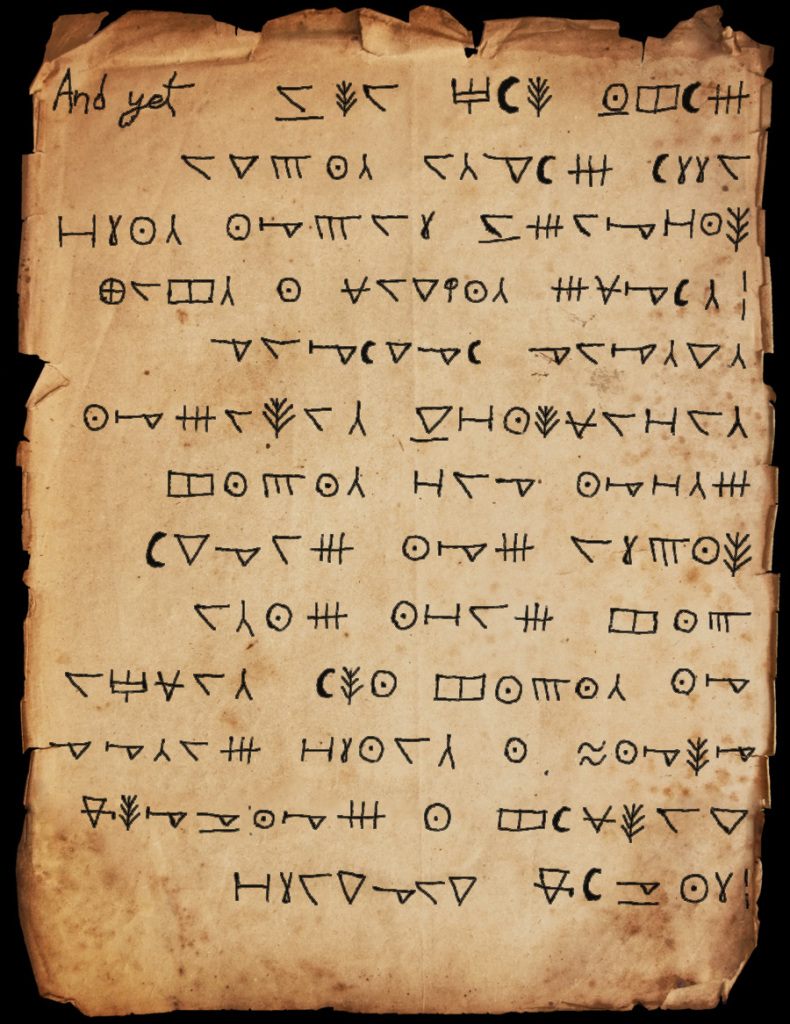
Erica Gull scrolled through the pages of symbols that comprised the rest of the manuscript. Closing the window, she felt the call to sleep and now in her bed shut her eyes to the conscious world. And now she saw the blue, underlined text that signified a link to another page and she was back again, meeting this promise with the gesture of a click, summoned to the black background. Summoned to the account of Lyemouth.